

Best ALDI Vegan Swaps in Australia
UPDATED: September 2026
If you’ve spent any time shopping for vegan food lately, you’ve probably noticed one thing pretty quickly. Prices can add up fast!
Between plant-based meats, snacks, frozen meals, convenience foods and lunchbox staples, it doesn’t take much for a weekly vegan grocery shop to suddenly feel expensive. And when you’re feeding a family on top of that, finding affordable vegan options that still taste good becomes even more important.
This is honestly one of the reasons I’ve started paying closer attention to ALDI’s vegan friendly items lately to find the ALDI’s best vegan purchases.
ALDI is a supermarket that is meant to be cheaper than the other supermarket heavy-weights in Coles and Woolworths, offering their own alternatives to well-known products at a more affordable price. While you won’t find everything at ALDI, the accidentally vegan range is actually quite extensive.
Over the past few months, I’ve been comparing some of ALDI’s vegan products against bigger brand-name alternatives to see just how similar they really are. Not just in terms of flavour, but also ingredients, texture, portion size, and overall value for money.
And to be honest? Some of the similarities have been surprisingly close.
This series isn’t about saying one product is “better” than another. Sometimes the branded version has added vitamins, slightly different ingredients, or packaging advantages. But if you’re trying to make vegan eating feel more affordable and accessible, these kind of supermarket swaps can genuinely add up quickly and make a difference over time.
The goal here is simple:
compare like-for-like vegan products
break down the ingredient differences
look at price savings
share honest taste impressions
help families find more budget-friendly vegan options in Australia
And as I continue testing more products, I’ll keep updating this list with new ALDI vegan swaps and hopefully pinpoint ALDI’s best vegan purchases for people to enjoy in Australia.
Popular ALDI Swaps:
ALDI Meat-Free Sausages vs Vegie Delights Thick BBQ Sausages
ALDI Beef Flavour Cup Noodles vs Maggi Beef Flavour Cup Noodles
ALDI Earth Grown Firm Tofu vs Macro Firm Tofu
ALDI Deli Originals Hommus vs Yumi's Hommus
ALDI Eton Original Crackers vs Arnott’s Savoy Original Crackers
ALDI Wholefood Balls vs Smooshed Wholefood Balls
ALDI SANZ Biscuits vs Arnott’s SAO Biscuits
ALDI Belmont Digestives vs McVities Digestives
Why ALDI Vegan Swaps Are Becoming So Popular
With the cost of groceries continuing to rise across Australia, more families are looking for ways to reduce their weekly spend without completely changing how they eat.
A lot of their plant-based alternatives are significantly cheaper than major branded products, while still delivering very similar ingredients, nutrition profiles, and taste experiences.
In some cases, the differences are minimal enough that most people probably wouldn’t notice in a blind taste test.
For busy families especially, these swaps can add up quickly over a month:
cheaper lunchbox snacks
lower-cost convenience meals
budget-friendly freezer staples
easier weeknight dinners
And realistically, when life is busy, convenience matters just as much as ingredients sometimes.
ALDI Meat-Free Sausages vs Vegie Delights Thick BBQ Sausages
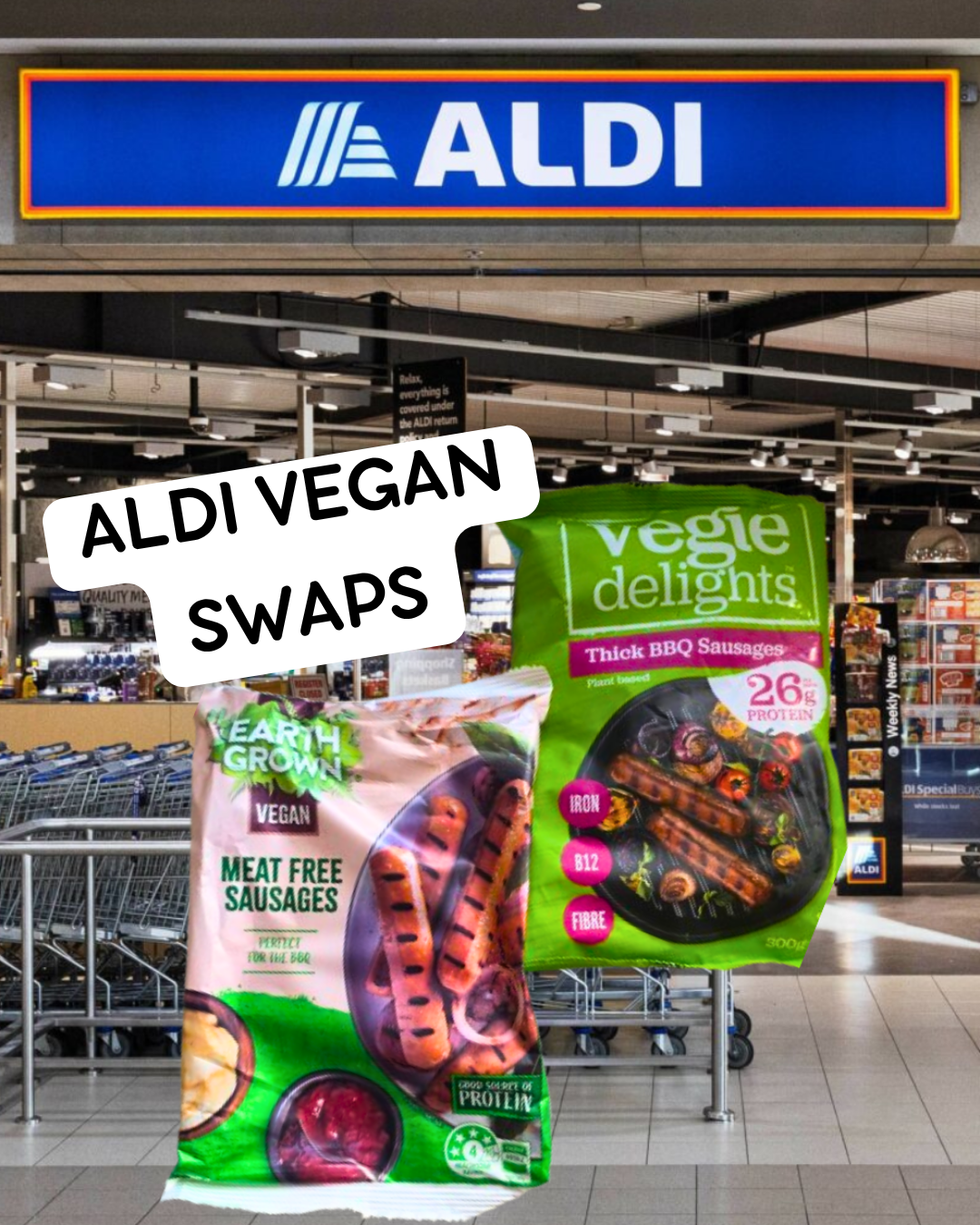
One of the first comparisons that really surprised me was the ALDI Earth Grown Meat Free Sausages compared to the Vegie Delights Thick BBQ Sausages.
At first glance, they honestly look almost identical, from the sausage appearance itself right through to the overall packaging style.
Price Comparison
ALDI Earth Grown Meat Free Sausages: $4.69 for 300g
Vegie Delights Thick BBQ Sausages: $7.50 for 300g
That makes the ALDI version approximately 37% cheaper.
And when you’re buying products like this regularly for lunches, dinners, BBQs or quick freezer meals, that difference adds up surprisingly quickly.
Ingredient Comparison
ALDI - Water, Vegetable Protein (22%) (Wheat, soy), Vegetable Oil, starches (Tapioca, Potato), Flavours (Wheat, soy), Oats, seasoning (Wheat, soy, barley), sugar, breadcrumbs (wheat), yeast extract, onion, mineral salt (Potassium chloride), garlic, salt
Vegie Delights - Water, vegetable protein (25%) (wheat, soy), vegetable oil, onion, seasoning (wheat, soy, barley), breadcrumbs (wheat), sugar, natural flavours, salt, yeast extract, wheat fibre, mineral salt (potassium chloride), garlic, vegetable gum (carageenan), emulsifier (soy lecithin), natural colour (caramel), minerals (zinc, iron), vitamin (b12),
The ALDI product contains added starches and oats but fewer supplemental vitamins, whereas the Vegie Delights product relies more heavily on onion and includes added binders (carrageenan), emulsifiers (soy lecithin), caramel colour, and is fortified with Zinc, Iron, and Vitamin B12.
Taste & Texture
This was honestly the biggest surprise.
Texture-wise, I could barely tell a difference between the two once cooked. Both had that same soft-but-firm plant-based sausage texture and very similar flavour profiles. If anything, the differences were extremely minor.
For everyday meals like:
sausage in bread
BBQs
quick dinner favs such as curried sausages
breakfast spreads
I honestly think most people would struggle to notice much difference at all!
And considering the price gap, this one feels like a very strong budget-friendly vegan swap.
ALDI Beef Flavour Cup Noodles vs Maggi Beef Flavour Cup Noodles
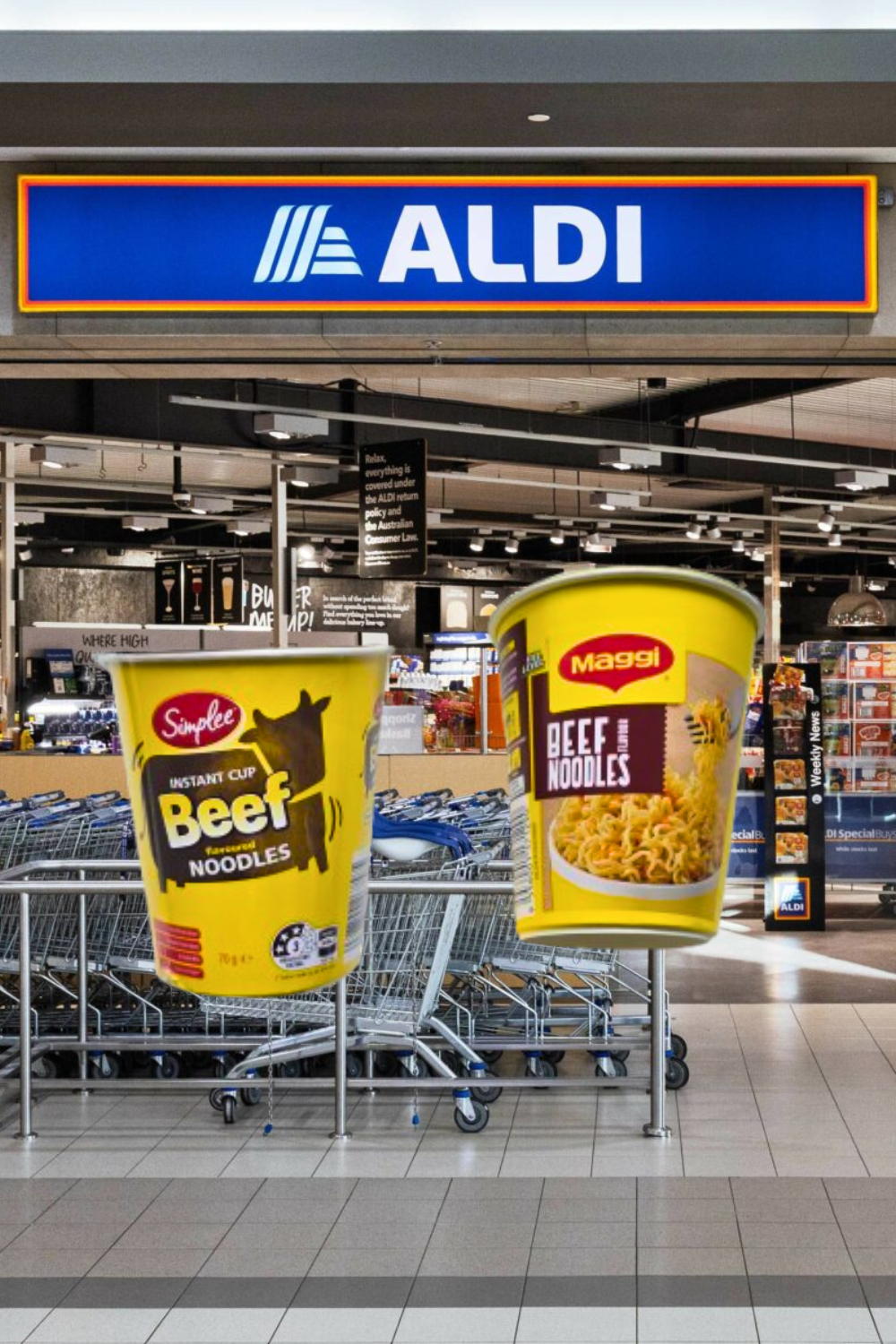
Instant noodles are one of those super convenient foods that almost everyone has sitting in the pantry at some point.
They’re quick, cheap, easy for busy nights, and honestly pretty handy for lunches or after-school snacks too.
So when I spotted the ALDI Beef Flavour Cup Noodles and noticed that they were vegan-friendly, I wanted to compare them to the much more expensive Maggi Beef Flavour Noodles.
Price Comparison
ALDI Beef Flavour Cup Noodles: $0.99 for 70g
Maggi Beef Flavour Cup Noodles: $3.00 for 58g
That makes the ALDI version approximately 67% cheaper, whilst also giving you a larger serving size.
That’s a pretty massive difference for something that’s essentially targeting the same convenience-food category.
Ingredient Comparison
ALDI - Instant noodles (91%) (wheat flour, palm oil, salt, stablisers (500, 501)), seasoning sachet (7%) (salt, sugar, flavour (wheat, soy), Maltodextrin, yeast extract, spices, soy sauce powder (wheat, soy), anticaking agent (551), natural colour (150a), flavour enhancer (disodium-5' Ribonucleotides), dried parsley and vegetable mix, colour (150d), garnish sachet (2%) (dried carrot, dried corn, dried peas)
Maggi - Australian wheat flour (60%), vegetable oil (antioxidant (319)), tapioca starch, salt, mineral salts (508, 451, 501, 500), vegetable gum (412). Mineral salt (potassium chloride), salt, flavour enhancers (621, 635), sugar, yeast extract, flavour, burnt sugar, vegetable fat (antioxidant (320)), onion, soy sauce powder (soy, wheat), food acid (citric), white pepper, rosemary, carrot
The ALDI version has a slightly simpler ingredient list with more actual veg and fewer additives, while the Maggi noodles rely a bit more on flavour enhancers and processing ingredients for that stronger instant noodle flavour.
Packaging Differences
One area where Maggi probably wins for me is their packaging.
The Maggi noodles come in a recyclable paper-based cup with a foil lid, while the ALDI version uses a plastic wrap and non-recyclable cup. That may matter to some shoppers depending on priorities around packaging waste and sustainability, but it is definitely something worth mentioning.
Taste & Texture
Texture-wise, they’re extremely similar. The noodle consistency is nearly identical once cooked, and both deliver that classic instant noodle flavour people expect.
The biggest difference for me was actually the seasoning strength. The Maggi version has a much stronger, more overpowering beef-style flavour, while the ALDI version tastes slightly lighter and less intense overall.
Personally, I actually preferred the ALDI version because the flavour felt a little less artificial and the added vegetables gave it slightly more texture.
And again, when you factor in the price difference, it becomes a pretty compelling swap.
ALDI Earth Grown Firm Tofu vs Macro Firm Tofu
More Details Here
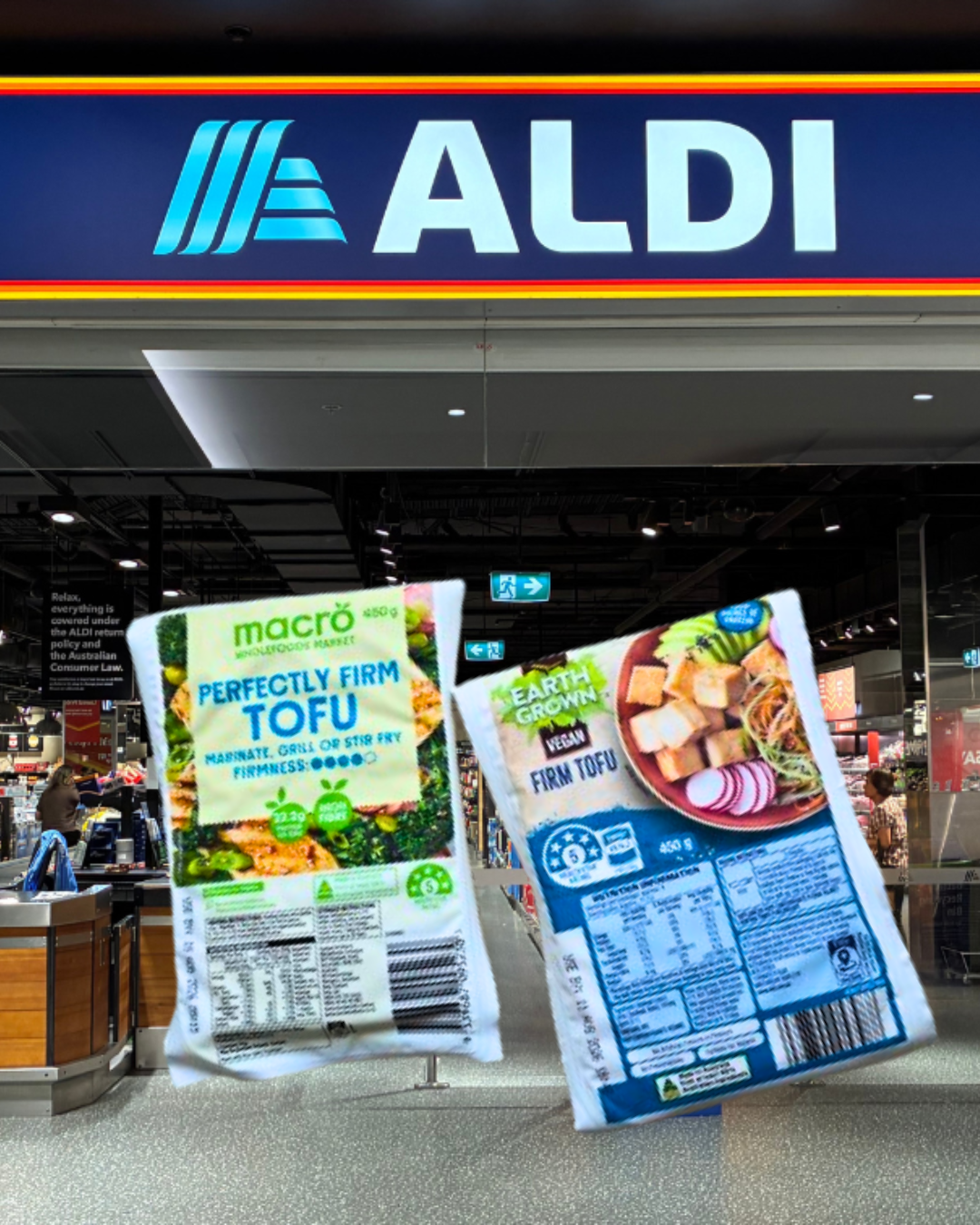
One thing I’ve noticed while doing these ALDI vegan swap comparisons is that some products are almost impossible to tell apart once they’re actually cooked. This firm tofu might be one of the best examples so far.
This comparison looks at the ALDI Earth Grown Firm Tofu against the Macro Firm Tofu, and honestly, the similarities are pretty surprising.
From the texture straight out of the packet to the way they cook in the pan, these two products are incredibly close.
For anyone regularly buying tofu for stir-fries, curries, wraps, tofu scrambles, or meal prep, this could easily become one of the simplest vegan grocery swaps to save a bit of money without really sacrificing anything.
Price Comparison
ALDI Earth Grown Firm Tofu: $2.59 for 450g
Macro Firm Tofu: $2.80 for 450g
That makes the ALDI version approximately 7.5% cheaper.
Now, the saving here obviously isn’t as dramatic as some of the other comparisons, but if tofu is something you buy multiples of every single week like our family does, those smaller savings still add up over time.
Ingredient Comparison
ALDI – soybean extract (98%) [soybean, water], firming agent (511).
Macro – soybean extract (99%) (water, soybean), firming agent (511)
Ingredient-wise, these are virtually identical.
The only real difference is that the Macro version contains 1% more soybean extract, but outside of that, both products use the exact same simple ingredient structure with very minimal processing.
Honestly, this is probably one of the cleanest and most straightforward ingredient comparisons I’ve done so far in this series.
Nutrition Comparison
When comparing the nutrition panels, the products are also extremely similar overall.
Macro: serving size = 150g. Energy = 194 calories, Protein = 22.2g, Fat, Total = 5.9g - saturated <1.0g, trans <0.1g, Carbohydrate = 8.4g, sugars <1.0g, Dietary fibre = 9.3g, sodium = <5.mg
ALDI: serving size = 113g, Energy = 132 calories, Protein = 16.7g, Fat, total = 4.4g, saturated 0.7g, Carbohydrate = 6.3g, sugars 0.4g, dietary fibre = 7.0g, sodium = 6mg
The Macro tofu is slightly higher in protein and fibre per serve, while the ALDI tofu comes in marginally lower in calories due to the smaller serving size listed on the packaging (113g serve) compared to the Macro tofu (150g serve).
Both options are:
high in plant-based protein
low in saturated fat
naturally filling
incredibly versatile for everyday cooking
For practical everyday use, the nutrition differences are honestly very minor.
Taste & Texture
This was another comparison where I genuinely struggled to notice any real difference.
Straight out of the packet, both tofu blocks looked almost identical and had the same firmness and texture.
Once cooked in a fry pan with a little oil, the similarities became even more obvious. The texture, mouthfeel, and overall flavour were virtually the same.
…I honestly think most people would find these two products interchangeable.
And that’s what makes these ALDI vegan swaps so interesting. Sometimes the cheaper option really is incredibly close to the more familiar supermarket brand alternative.
ALDI Deli Originals Hommus vs Yumi's Hommus
More Details Here
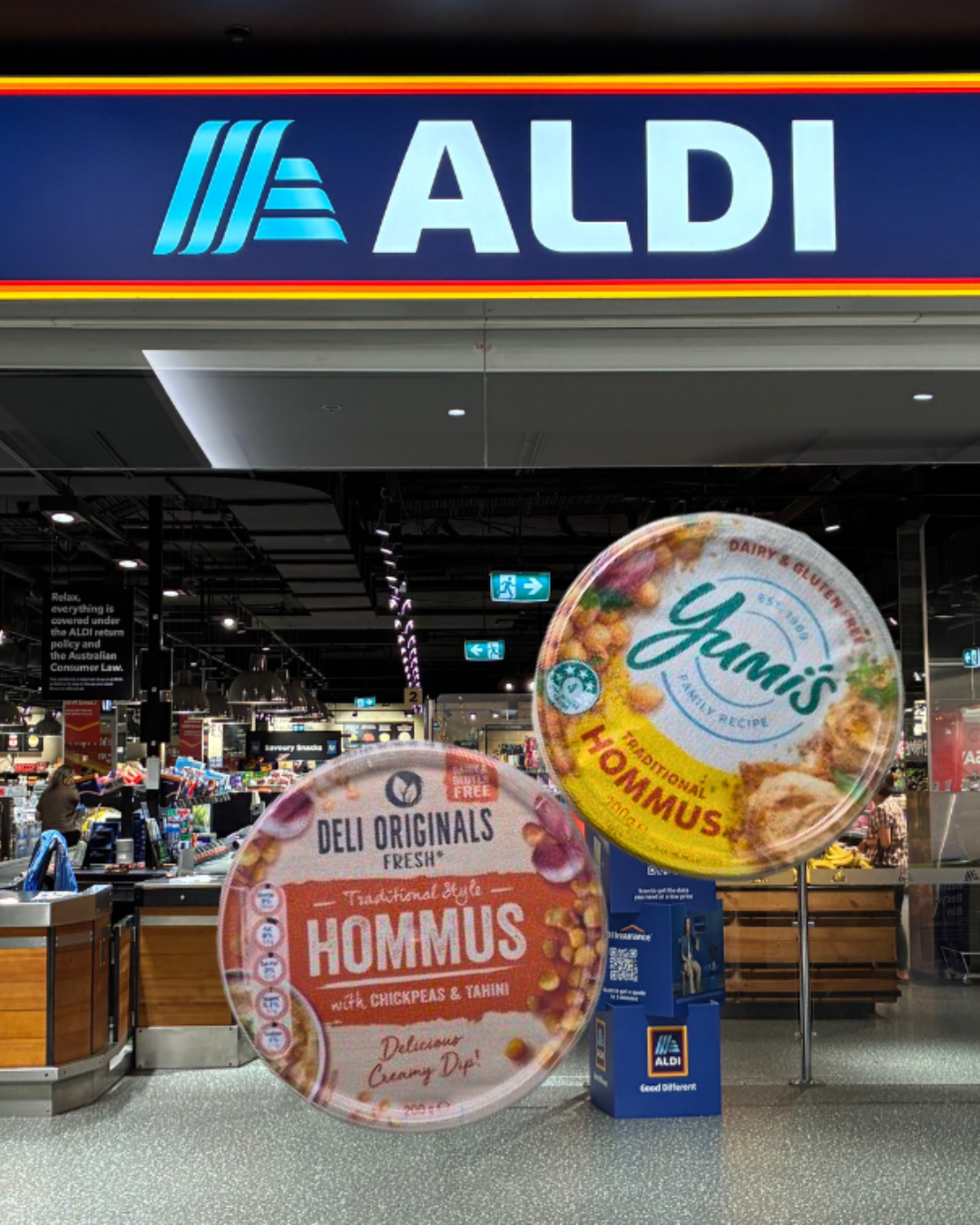
Hommus is one of those staple items that seems to find its way into our trolley quite regularly.
Whether it's spread on wraps, served with veggie sticks, added to the kid’s lunchboxes, or used as a quick snack, it's one of those versatile products that gets plenty of use in our house.
This comparison takes a look at the ALDI Deli Originals Hommus and the popular Yumi's Hommus to see whether the significant price difference actually translates into a noticeable difference in quality, ingredients, or taste.
Price Comparison
ALDI Deli Originals Hommus: $2.49 for 200g
Yumi's Hommus: $5.00 for 200g
That makes the ALDI version approximately 50% cheaper than the Yumi's equivalent.
This is one of the bigger savings I've found so far in these ALDI vegan swap comparisons, particularly for a product many families buy regularly.
Ingredient Comparison
ALDI – Cooked chickpeas (66%) (chickpeas, water), vegetable oil, tahini paste (13%) (sesame seed paste), acidity regulators (260, 330, 575), salt, garlic (0.50%), preservative (202).
Yumi's – Cooked chickpeas (66%), canola oil, tahini paste (sesame), acidity regulator (575), salt, food acids (citric acid, acetic acid), garlic (0.5%), mineral salt (sodium bicarbonate), preservative (202).
The ingredient lists are remarkably similar, with the main difference being that Yumi's specifies canola oil, while ALDI uses a more general vegetable oil and lists its acidity regulators slightly differently.
Overall, both products rely on the same core ingredients: chickpeas, tahini, garlic, oil, and seasoning.
Nutrition Comparison
The nutrition panels are almost a mirror image of each other.
Per 20g Serve ALDI Yumi's
Calories 66 63
Protein 1.4g 1.4g
Fat 5.3g 5.0g
Saturated Fat 0.7g 0.5g
Carbohydrates 3.3g 3.3g
Sugars 0.1g 0.1g
Sodium 77mg 82mg
Nutritionally, the differences are extremely minor. ALDI is slightly higher in calories and total fat, while Yumi's is marginally lower in saturated fat and slightly higher in sodium.
For everyday use, most people would never notice the difference.
Taste & Texture
This was another comparison where the products were incredibly difficult to separate.
Visually, both hommus products look almost identical straight out of the tub and have the same smooth, creamy consistency. Taste-wise, they're very close as well. The only difference I noticed was that the Yumi's Hommus seemed to have a slightly stronger lemon flavour, giving it a touch more brightness. Outside of that, the texture, creaminess, and overall eating experience were extremely similar.
I think most people would struggle to tell which one they’re eating.
Considering that the ALDI version costs half the price, this is another great ALDI vegan swap that offers some pretty impressive value without the sacrifice in terms of taste or quality.
Some of my favourite ways to use hommus:
Veggie Sticks and Crackers
Nourish Bowls
Wraps
ALDI Eton Original Crackers vs Arnott’s Savoy Original Crackers
More Details Here
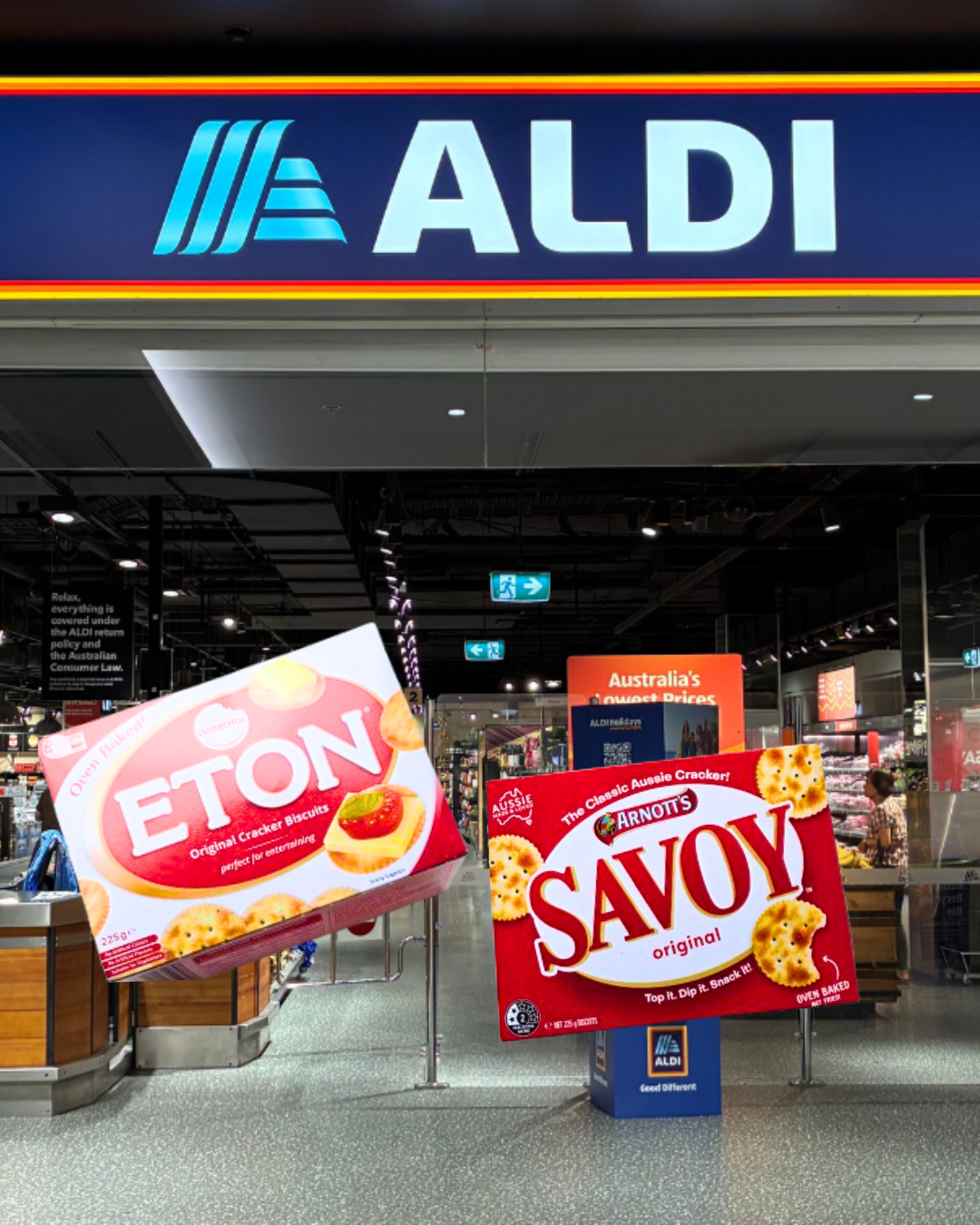
Crackers are one of those things that seem to disappear quickly in our house.
Whether it’s after-school snacks, something to throw into lunchboxes, or a quick bite between kids’ sport runs, we always seem to have a box open on the bench.
Because we go through them so often, I’ve started paying a lot more attention to price and whether there are actually any noticeable differences between the budget and mainstream options.
This comparison between ALDI’s Eton Original Crackers and Arnott’s Savoy Crackers is a perfect example of that “everyday staple” test.
Price Comparison
Eton Crackers (ALDI): $1.49 for 225g
Arnott’s Savoy: $4.00 for 225g
The ALDI crackers are approximately 63% cheaper.
This is one of those simple pantry swaps that adds up quickly, especially for households that regularly buy crackers for snacks, lunchboxes, or entertaining.
Ingredient Comparison
ALDI – Wheat flour, vegetable oils (includes palm oil, antioxidant (307b)(soy)), sugar, salt, raising agent (500), yeast, acidity regulator (330), barley malt extract, herb extract.
Arnott’s Savoy – Wheat flour, vegetable oil (antioxidant (307b from soy)), salt, sugar, yeast, golden syrup, baking powder, herb extract, malt extract (barley), emulsifier (soy lecithin).
The ingredient lists are very similar overall, with both products built around wheat flour, oils, and basic leavening agents. The main differences are that Savoy includes golden syrup and soy lecithin, while the ALDI version uses an acidity regulator and a simpler raising agent system.
Both are still very comparable everyday crackers.
Nutrition Comparison
The nutrition panels are almost a mirror image of each other.
Per 16g Serve ALDI Savoy
Energy 316kj 316kj
Protein 1.2g 1.3g
Fat 2.9g 3.2g
Saturated Fat 0.7g 0.7g
Carbohydrates 10.8g 10.1g
Sugars 1.2g 0.2g
Sodium 80mg 136mg
Nutritionally, both products are extremely similar per serve.
Savoy is slightly lower in sugar, while ALDI crackers contain marginally less sodium depending on serving size. Outside of those minor variations, there are no meaningful nutritional differences between the two products.
For everyday snacking, dips, or lunchboxes, both sit in a very similar range.
Taste & Texture
This is where things get interesting.
The ALDI crackers have a slightly lighter texture and a more subtle sweetness, almost giving them a hybrid feel between a Savoy and a Jatz-style cracker.
Savoy crackers are a little more traditional in flavour and slightly crunchier, with a more savoury finish overall.
That said, the differences are subtle. Most people would likely be happy with either.
This is another strong ALDI swap where the biggest difference is clearly price rather than product experience.
If you’re buying crackers regularly for snacks, dips, or lunchbox fillers, this is one of the easier swaps to make without noticing much change at all.
ALDI Wholefood Balls vs Smooshed Wholefood Balls
More Details Here
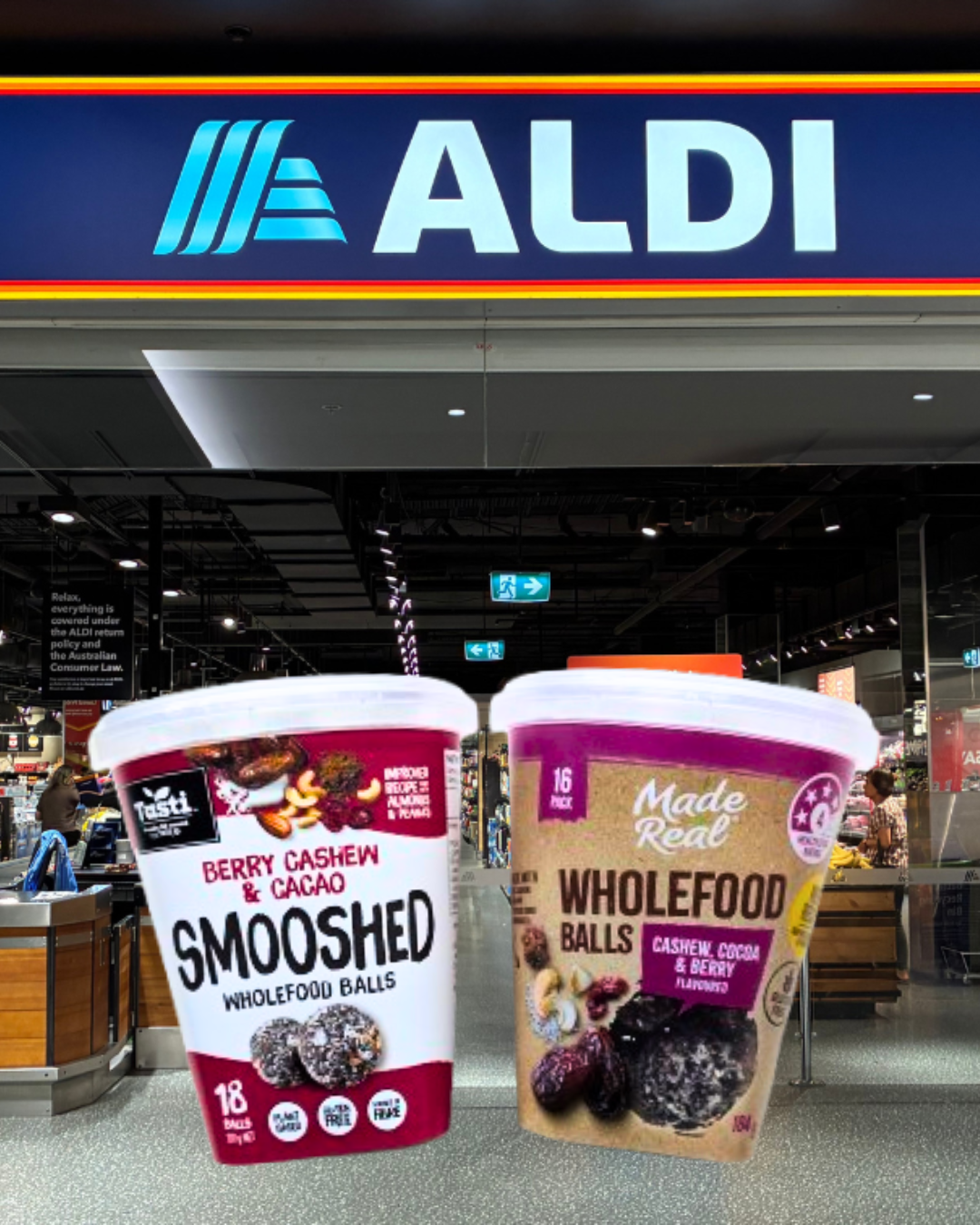
These wholefood-style snack balls are something I’ve leaned on more and more lately, especially with two boys constantly on the go with school, basketball, footy and everything in between.
They’re one of those easy grab-and-go snacks that can live in the pantry or lunchbox without much thinking. But with so many brands now in this space, I’ve started comparing a few of the popular options to see whether the higher price tags actually translate into anything meaningful. This one looks at ALDI’s Wholefood Balls compared to Smooshed.
Price Comparison
ALDI Wholefood Balls: $4.69 for 184g
Smooshed Wholefood Balls: $7.50 for 207g
Equivalent ALDI pack size (184g adjusted): approx. $6.67
The ALDI wholefood balls are approximately 30% cheaper.
This is a great example of how snack-style “health balls” can vary significantly in price for what is often a very similar product.
Ingredient Comparison
ALDI – Dates (60%), roasted cashews (19%), alkalised cocoa powder (10%), sweetened dried cranberries (5%), desiccated coconut (3.5%), date syrup, natural flavours, almond, roasted peanut.
Smooshed Wholefood Balls – Dates, cashews (19%), cacao powder (10%), dried cranberries (5%), desiccated coconut, date syrup, natural flavour, almond, peanuts.
The ingredient lists are almost identical for the Smooshed Wholefood Balls compared to the ALDI Wholefood Balls.
The key differences are that ALDI provides clearer percentages, uses roasted nuts, and uses alkalised cocoa powder instead of standard cacao powder. Otherwise, both products rely on the same base structure of dates, nuts, dried fruit, and coconut.
Nutrition Comparison
The nutrition panels are almost a mirror image of each other.
Per 46g Serve ALDI Smooshed
Energy 708kj 772kj
Protein 4.0g 3.3g
Fat 6.2g 5.6g
Saturated Fat 1.6g 2.0g
Carbohydrates 21.9g 27.6g
Sugars 20.1g 22.6g
Sodium 5mg 7mg
Despite the slight differences in pack size, both products are nutritionally very similar.
ALDI wholefood balls come in slightly higher for protein and fibre per serve, while overall calories, fats, and sugars remain closely matched between the two.
For most consumers, there would be no meaningful nutritional difference in everyday use.
Taste & Texture
Honestly, this is one of the closest comparisons so far.
Texture, flavour, and sweetness levels are extremely similar. If these were served without packaging, most people would struggle to confidently tell them apart.
The ALDI version holds up very well as a direct alternative, and much affordable too!
This comparison between Smooshed wholefood balls and ALDI’s alternative is a strong example of a premium snack category where branding plays a big role in pricing.
From a practical standpoint, both options perform almost identically.
ALDI SANZ vs Arnott's SAO
More Details Here
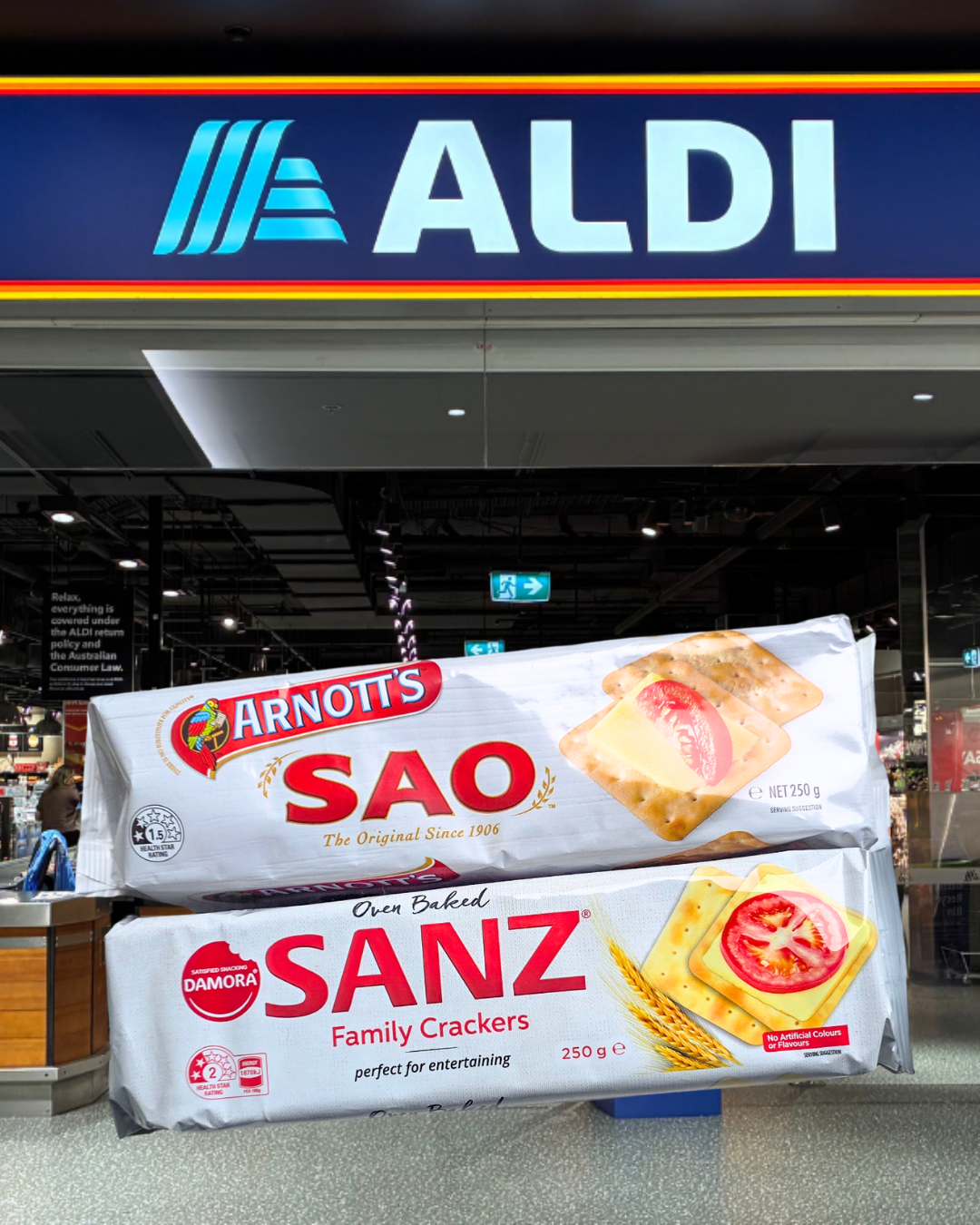
SAO crackers are one of those pantry staples that are incredibly versatile. You can spread them with Vegemite, peanut butter, avocado, hummus or whatever else you have on hand.But these crackers are also a great example of how much the price of very similar supermarket staples can vary. So, for this comparison, I'm putting ALDI SANZ up against the much more recognisable Arnott's SAO to see whether there's really much difference beyond the branding.
Price Comparison
ALDI SANZ: $0.95 for 250g
Arnott's SAO: $4.00 for 250g
The ALDI SANZ crackers are approximately 76% cheaper than Arnott's SAO on an equivalent 250g basis.
That's a huge difference for what are essentially very similar pantry crackers, and is one of those comparisons where the price difference is immediately noticeable!
Ingredient Comparison
ALDI SANZ – Wheat flour, fractionated palm fat (includes antioxidant 307b), salt, barley malt extract, dried yeast, raising agents (500, 503).
Arnott's SAO – Wheat flour, vegetable oil (antioxidant 307b from soy), salt, yeast, malt extract (from barley), sugar, baking powder, emulsifier (soy lecithin).
The ingredient lists are very similar, with both products built around wheat flour, vegetable/palm fat, salt, yeast and barley malt extract. There are some differences, though.
Arnott's includes sugar and soy lecithin, while the ALDI version doesn't list either of these ingredients. ALDI uses fractionated palm fat, whereas Arnott's uses vegetable oil. The raising agents also differ slightly, with ALDI listing 500 and 503, while Arnott's uses baking powder.
Overall, though, there's nothing jumping out from the ingredient lists that would explain a 76% price difference.
Nutrition Comparison
Per 46g Serve ALDI Arnott’s
Energy 318kj 323kj
Protein 1.5g 1.7g
Fat 2.0g 2.6g
Saturated Fat 0.9g 1.4g
Carbohydrates 12.5g 11.4g
Sugars 0.5g 0.5g
Dietary Fibre - 0.7g
Sodium 114mg 122mg
Nutritionally, these are remarkably close.
Arnott's comes in VERY slightly higher for protein, fat and saturated fat, while ALDI is slightly higher in carbohydrates.
Both contain just 0.5g of sugar per equivalent serve. Sodium is also very similar, with ALDI at 114mg compared with approximately 122mg for Arnott's.
Again, the biggest difference here isn't really nutritional at all… it's the price.
Taste & Texture
After trying both, I found the taste and flavour to be essentially identical. Both have that familiar, mild water-cracker style flavour, and I honestly couldn't pick a clear winner based on taste alone.
The biggest difference was in the texture. The Arnott's SAOs were noticeably more aerated, which you could immediately tell as soon as you pulled them from the packet. The different raising agents used in each product appear to make a noticeable difference here.
Both had a really good crunch, but the Arnott's SAOs felt slightly thicker and more substantial, while the ALDI SANZ crackers were a little denser.
So, when it comes to flavour, they're remarkably similar. The main difference comes down to texture, with the Arnott's SAO having that slightly more aerated, thicker crunch.
On paper, this is another pretty interesting ALDI comparison. The ingredient lists are remarkably similar, and the nutritional differences are relatively minor. However, the price difference is anything but minor.
ALDI Belmont Digestives vs McVitie’s Digestives
More Details Here
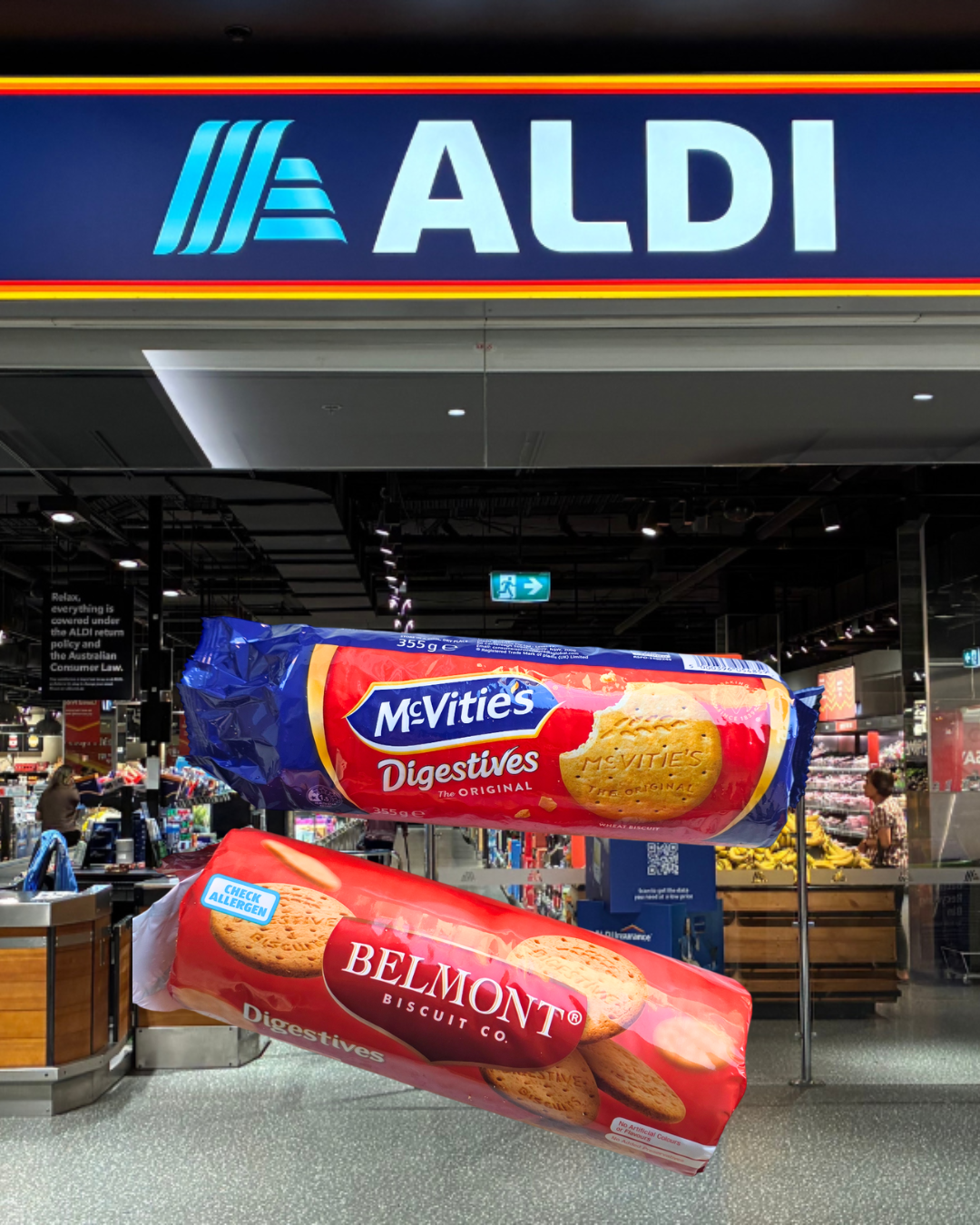
Digestive biscuits are another pantry staple where you can find a pretty big difference in price between supermarket brands. For this comparison, I’m putting the ALDI Belmont Digestives up against the much more recognisable McVitie’s Digestives to see how different they really are.
Price Comparison
ALDI Belmont Digestives: $2.99 for 400g
McVitie’s Digestives: $5.50 for 355g
When scaled to the same 400g amount, McVitie’s works out at approximately $6.20 for 400g.
The ALDI Belmont Digestives are therefore approximately 52% cheaper than McVitie’s on an equivalent 400g basis.
That's a pretty significant saving for two biscuits that, at first glance, look like they're doing a very similar job!
Ingredient Comparison
ALDI Belmont – Wheat flour (55%), palm oil, wholemeal wheat flour (16%), sugar, invert sugar syrup, raising agents (500, 503, 330), salt.
McVitie’s – Wheat flour (50%), wholemeal wheat flour (14%), palm oil, sugar, raising agents (500ii, 503ii), salt, acidity regulator (296).
The ingredient lists are very similar, with both products built around wheat flour, wholemeal wheat flour, palm oil, sugar, raising agents and salt.
There are a few differences, though. Belmont contains slightly more wheat flour and wholemeal wheat flour, as well as invert sugar syrup. It also lists raising agent 330, while McVitie's uses an additional acidity regulator, 296.
Overall, though, they're remarkably similar ingredient-wise, especially considering the difference in price.
Nutrition Comparison
Per 15g serve (approximately 1 biscuit)
ALDI McVities
Energy 73kj 71kj
Protein 1.0g 1.0g
Fat 3.1g 3.2g
Saturated Fat 1.5g 1.5g
Carbohydrates 9.9g 9.5g
Sugars 2.4g 2.3g
Sodium 46mg 74mg
McVitie’s values have been scaled from its 14.8g serving to 15g for a fair comparison.
Nutritionally, these are very close.
McVitie's is marginally lower in calories, carbohydrates and sugar, while Belmont is slightly lower in fat and has noticeably less sodium. Protein and saturated fat are essentially identical.
Again, there isn't a huge nutritional difference here. The standout difference is probably the sodium, but even that isn't something that would make one biscuit dramatically different from the other.
Taste & Texture
Both biscuits have a similar-sized, aerated texture and a very similar wheaty, semi-sweet flavour. The ALDI version is perhaps very, very slightly sweeter, but honestly, the difference in both taste and texture is hardly noticeable. If you were given the two without seeing the packaging, I don't think you'd be able to tell which one was which.
For a product comparison, that's probably the biggest takeaway: whatever differences exist in the ingredients and nutrition panel, they don't translate into an obvious difference when you actually eat them.
If you have any suggestions for future ALDI vegan swap comparisons, please reach out.